The problem
You shouldn't have to discover whether a new provider works after you've already switched.
Switching utility bill management providers is a consequential decision. It moves live bills, real due dates, and portal access for accounts that can be disconnected if something slips. The bills don't pause while the transition happens, and the first one that falls through shows up weeks later as a late fee, or worse. Anyone who tells you switching is painless hasn't done it.
So most teams stay put, even when they suspect their current process is falling short. But staying carries risk too. If bills are being missed, errors are going through unvalidated, or accounts have quietly stopped producing bills, that's happening right now, and nobody is sending you a report about it. The same is true if there's no provider at all and your team is holding it together across portals, inboxes, and mail.
You shouldn't have to choose between those risks on promises. The only honest way to decide is with evidence from your own portfolio: your accounts, your utilities, your billing cycles. That's what the assessment is for.
When teams run the assessment
You don't need to be ready to switch.
Acquired locations
Establish the account inventory before bills disappear in the handoff.
Contract renewal approaching
Validate the incumbent operation before renewing another term.
Provider dissatisfaction
Test an alternative without disrupting the operation that's already running.
Bringing bill management in-house, or outsourcing it
Establish a baseline before changing ownership of the process.
The offer
A fixed-scope assessment, run in parallel. Not a trial, not a demo.
Whether your bills are managed by another provider or by your own team, the run works the same way. We operate a defined slice of your portfolio in full, in parallel, while nothing about your current operation changes.
Assessments start at $1,000. The price is fixed by the scope you choose: locations, accounts, utilities, and portals.
You get MeterID in full for two complete billing cycles. The actual operating model, run against your real accounts.
Choose the locations where operational continuity matters most. Around 20 locations or 60 meters is usually enough to reach a verdict; if you want broader coverage, we'll scope it that way. Some customers pick their most sensitive sites. Others deliberately choose a mix of utilities, states, account types, and billing complexity to stress-test us. Both are good tests.
Payments stay with your AP team. MeterID doesn't pay bills, during the run or in production. We collect, validate, and flag, then deliver daily AP-ready batch files your team can pay from. What you're evaluating is the real operation, end to end.
Every parallel run starts with a scoping call. We confirm the portfolio is a fit, agree on the locations and accounts in scope, and set the start date. Then we get to work.
Credentials and access
Yes, we'll need portal access. Here's exactly how we handle it.
To run the portfolio independently, MeterID needs access to the utility portals for the accounts in scope. We do not need access to your current provider's platform, reporting, or internal workflow. Credentials go into our encrypted vault, access is monitored continuously, and credentials are never shared. If you walk away at day 60, access is revoked and credentials are deleted.
How we handle credentialsWhat happens during the assessment
What you'll actually be able to answer at the end.
By day 60, these stop being questions you answer with a feeling and start being questions you answer with a log:
Did every bill arrive when expected?
MeterID tracks expected billing activity for every account in scope and surfaces anything that doesn't show up.
Are the accounts we think we're managing actually being managed?
We establish the account and meter inventory and monitor it independently, so the portfolio you think you have and the portfolio you actually have get reconciled.
Are exceptions getting caught early enough?
Missing bills, unusual charges, portal issues, zero-usage bills, service-period problems, and other exceptions are surfaced for review as they happen, not at month-end.
Can we actually see what's happening across the portfolio?
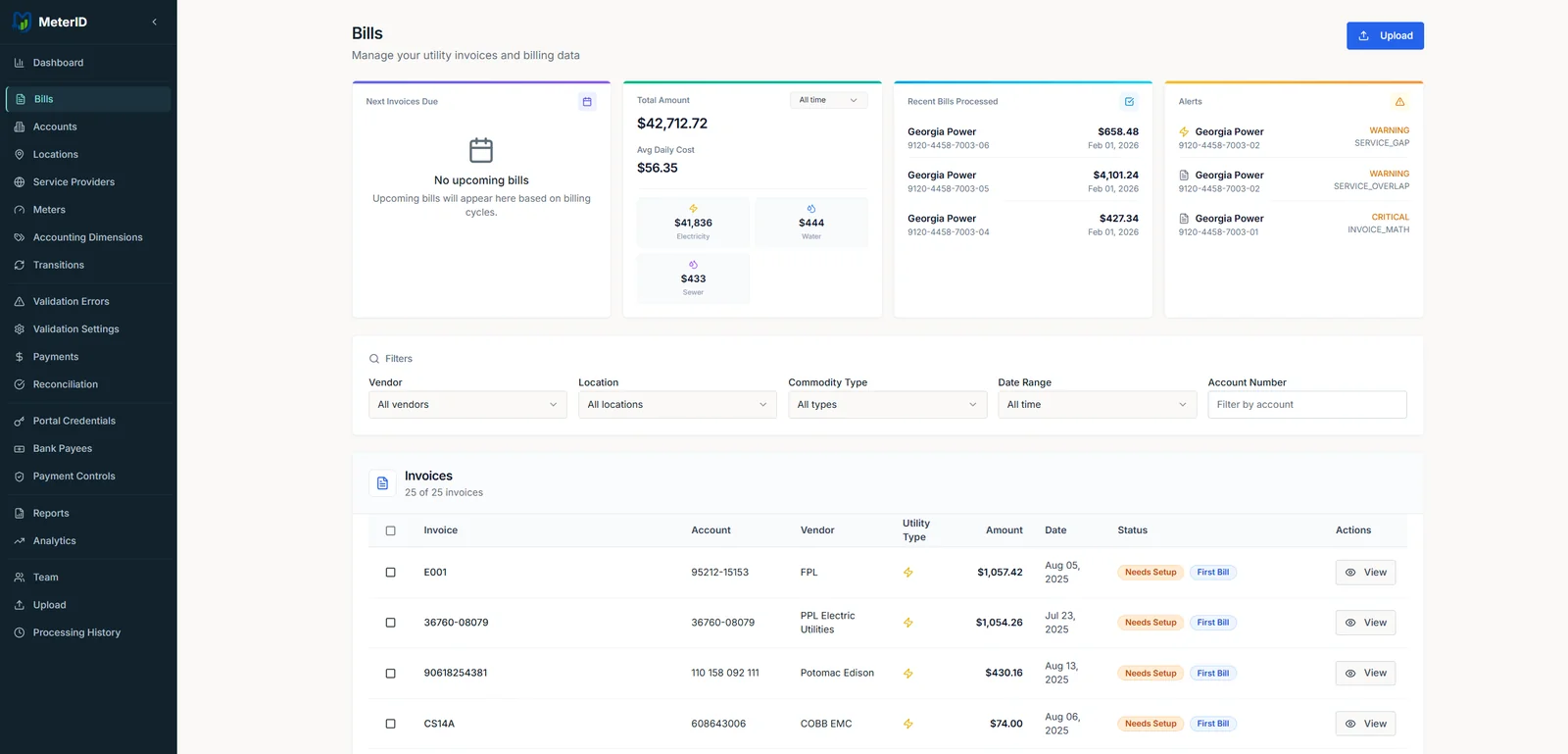
You get the same visibility and controls MeterID customers use in production. Every bill, flag, and approval, traceable.
The deliverable
The Utility Operations Assessment: what you receive
At the end of the engagement, your team receives a documented Utility Operations Assessment covering the full scope:
- Verified account and meter inventory for the assessment scope
- Expected-versus-received bill record for every account
- Missing bill and access-issue log
- Validation findings and anomalies
- Documented exceptions and their resolution status
- Side-by-side comparison against your existing process, if you elect to provide those records
- Recommendations for any operational gaps identified
You keep the assessment whether or not you hire MeterID.
You do not have to give MeterID access to your current provider's platform or internal reporting. How the comparison happens is your call:
Compare it yourself
Keep the evaluation completely independent. We hand over our full operating record, and your team compares it against your existing process.
Have us build the comparison
Share whatever incumbent or internal records you're comfortable with, and MeterID prepares the side-by-side comparison for you.
If your current process catches everything we catch, that's a useful result too. The point is to give you evidence, not manufacture a reason to switch.
If you continue
If you decide to continue, you don't start over.
The accounts, billing cycles, utility portal access, validation rules, and operating history established during the assessment become the foundation of your MeterID implementation. By day 60, the riskiest part of switching providers, the discovery and access work, is already done. Continuing is an expansion of scope, not a new project.
If you decide to switch
We don't treat transition as an administrative handoff.
Most of what goes wrong in a provider switch goes wrong because nobody mapped what had to move. We're comfortable asking you to consider changing providers because we've built the controls that make changing providers safe. This is the sequence we run:
Portfolio inventory
Establish the complete account and meter inventory before anything moves. You can't transition what nobody has mapped.
Access and credentials
Document every bill-access method, portal, and login. Credentials are vaulted, and access is verified working before cutover, not after.
Billing cycles and in-flight invoices
Map expected invoice cycles and identify every invoice already in process, so nothing falls between providers.
Cutover date and payment responsibility
A defined date, a defined owner for every payment, and a plan for bills still routing to the old provider.
Open balances and reconciliation
Reconcile open balances at cutover so the first month on MeterID starts clean.
Exception ownership
Agree on who handles what when something goes wrong, before it does.
Our case study walks this same sequence across a composite 42-location portfolio, drawn from real engagements: zero late fees, zero disconnect notices, zero lost accounts.
Assessment FAQ
Questions teams ask before they start
Is it exactly 60 days?
The goal is two complete billing cycles for every monthly-billed account. Depending on where your cycles fall relative to the start date, that can run 70 or 80 days. We don't cut the run short of two cycles just to hit a calendar number: one cycle proves a bill arrived, two cycles prove the process works. For quarterly-billed accounts, we cover at least one full cycle.
What does the assessment cost?
Assessments start at $1,000. The price is fixed by the scope you choose: the number of locations, accounts, utilities, and portals we assess. You'll have the exact number on the scoping call, before anything begins. If you move forward with MeterID, 100% of the fee is credited toward your first year.
Does anything change with our current provider or process?
No. Your existing process keeps running exactly as it does today. MeterID operates alongside it, collecting, validating, and flagging in parallel. Payments stay with your AP team, as they do for every MeterID customer: we deliver daily AP-ready batch files rather than paying bills.
Do you need access to our current provider's system?
No. We need access to the utility accounts in scope so we can operate independently, but we do not need access to your current provider's platform or your internal bill-management system. If you want us to prepare the final side-by-side comparison, you can share the relevant records with us. If you prefer to keep the evaluation independent, we'll provide our complete results and you can compare them yourself.
We don't have a bill management provider today. Is this still for us?
Yes. The parallel run isn't a provider-versus-provider exercise; it's an evidence-versus-assumptions exercise. If your team handles bills in-house through portals, email, and mail, we run alongside that process the same way. At the end, you get MeterID's complete operating record and can compare it against your internal process yourself, or share the relevant records with us and have us prepare the comparison.
What do you need from us to start?
A scoping call, the list of in-scope locations and accounts, and portal access for those accounts. How much time that takes on your side depends on how your portfolio is set up: how many portals you have, whether bills arrive electronically or by mail, and how many accounts are in scope. We'd rather give you an honest estimate on the scoping call than a number invented for this page. Most of the lift on your side is front-loaded in the first couple of weeks.
What happens to our credentials if we don't move forward?
Access is revoked and credentials are deleted from the vault. Our trust center covers the full credential lifecycle, from intake to deletion.
How we handle credentialsWhat happens at day 60?
You receive the complete Utility Operations Assessment and we walk through the findings together in a working session. If you've asked us to prepare a side-by-side comparison, we review that too. If you decide to move forward, the transition sequence on this page is how we run the cutover, built on everything already established during the assessment. If you don't, we revoke access, delete credentials, and you keep the assessment.
We're comfortable putting our work next to your existing operation. If we identify meaningful gaps, you'll see them. If your current process performs just as well, you'll see that too. We'd rather lose on evidence than win on promises.
Pick 20 locations. Let us prove it.
One scoping call to confirm fit, map the accounts, and fix the price. Then two billing cycles of evidence from your own portfolio, a documented assessment, and a decision you can defend either way.
Not sure yet? See how a 42-location transition runs, step by step