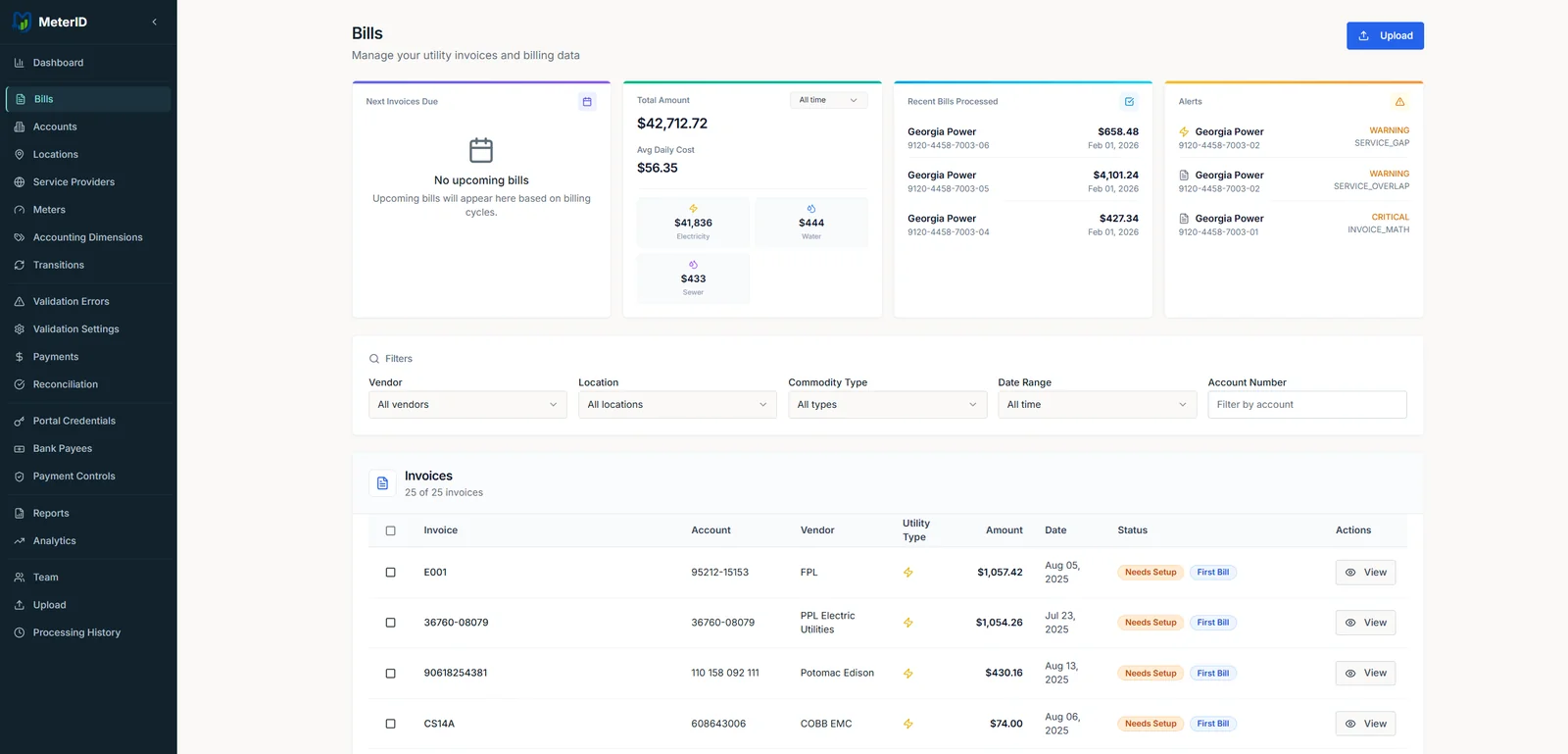
Built for owners and operators managing utility bills across multiple commercial properties — office, retail, industrial, and mixed-use portfolios.
Utility bill management gets messy fast in commercial real estate.
The challenge is not the number of bills. Properties change hands, tenants turn over, and a single meter may serve multiple parties. The account history has to remain clear through every change.
Properties change hands
Acquisitions and dispositions can split utility account history across owners, entities, and systems. MeterID tracks the account through each ownership change, including the prior and new account numbers, names on the account, transition date, and tax ID for each entity. This allows your team to separate pre- and post-transition activity without reconstructing the history later.
Meters don't map neatly to tenants
House meters, direct-metered suites, common areas, vacant space, and tenant-specific service all coexist in one building. That relationship is difficult to track in systems organized around properties, tenants, or invoices rather than utility meters.
Every utility works differently
A portfolio can span dozens of utility providers, each with its own portal, bill format, and billing cycle. MeterID centralizes utility portal access, credentials, emailed invoices, and paper bills instead of leaving them spread across the property management team's inboxes and files.
A missing bill becomes an AP problem
Bills are especially likely to stop arriving for vacant units and properties in transition, and the gap may not be noticed until a late notice or shutoff arrives. Expected bills are tracked whether or not they show up.
Property and accounting teams need different things
Operations teams need visibility into exceptions and the context behind them. AP needs consistent, coded, validated data on a predictable schedule. The process should support both teams without creating duplicate work.
Portal credentials are stored in an encrypted vault and monitored continuously. How we handle credentials
One managed process across the whole portfolio.
Onboarding maps your properties, entities, accounts, and meters. From there, the managed service keeps those records current as the portfolio changes.
Collect
Accounts inherited during acquisitions, vacant-space accounts, landlord-controlled service, and common-area meters all get mapped to the right property and entity. Bills come in by portal, email, and paper across every provider in the portfolio.
Validate
Each bill is checked for internal consistency and compared with the account's history. MeterID verifies the property, account, and meter relationships and flags overlapping or missing service periods, duplicate bills during ownership changes, and unusual shared-meter charges. Each flag records the reason it was raised.
Deliver
Validated data arrives coded to your entity and property structure, in the AP format your accounting team already uses, on the cadence you set. Allocation detail comes with it where applicable.
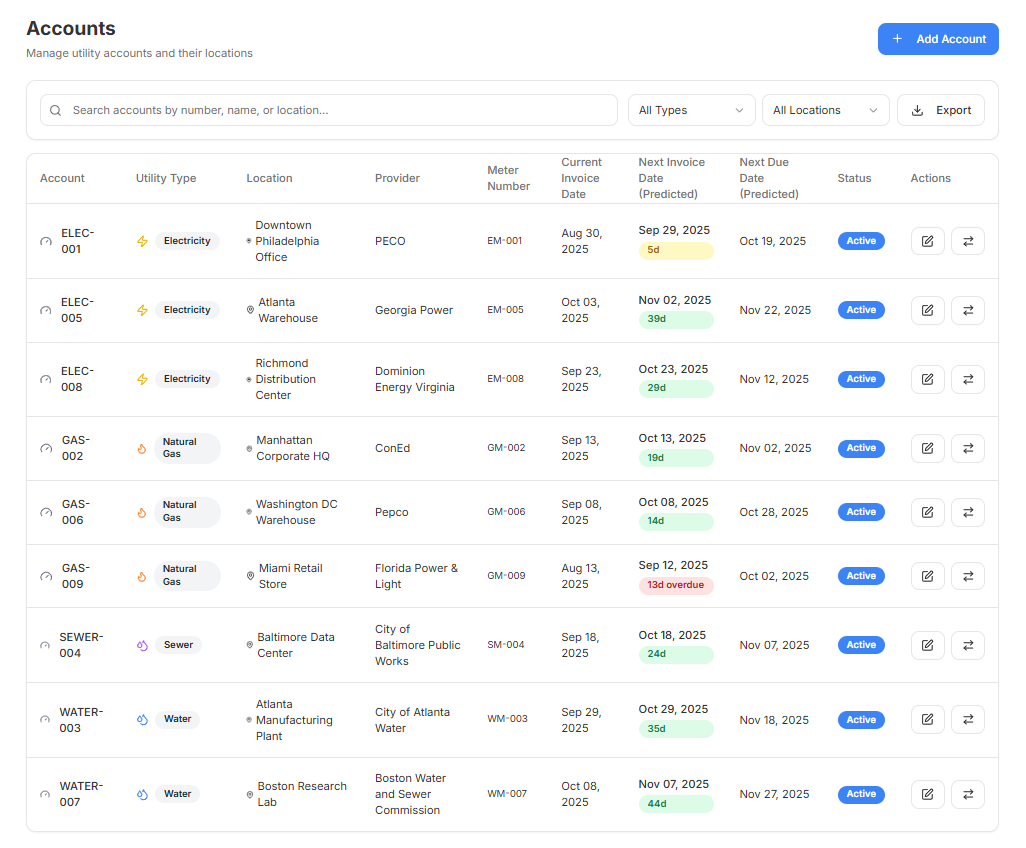
Every number can be traced to the source bill.
Bills are validated before they reach your accounting team, and every flag explains why it was raised.
Cost spike detection
Unexpected changes in cost or usage are flagged against the account's own history before the bill reaches AP.
Allocation reconciliation
Tenant shares, owner-retained amounts, and lease-excluded costs are reconciled to the source bill.
Duplicate detection
Flags the same bill entering the workflow twice, including during an ownership change or a provider transition.
Math verification
Line items are checked against the stated totals so utility billing errors are not passed through to AP.
The full account history stays intact through a sale.
When ownership changes, utility accounts often change too: new account numbers, a new name and tax ID, and change-of-ownership paperwork that the utility must process. MeterID records the transition without overwriting the prior account history.
Prior and current account details
The prior account number and name on account stay on the record alongside the new ones, rather than being overwritten when the account changes.
Tax ID on each account
The tax ID for each ownership entity is tracked with the account so bills are assigned to the correct entity before and after the transfer.
Transition dates
MeterID records the transition date, the last bill on the prior account, and the first bill on the new account — the period when bills are most likely to go missing.
Paperwork status
Whether change-of-ownership paperwork has been filed with the utility, and when it was confirmed, is tracked per account rather than left in an email thread.
A change of ownership is one of the points where bills are most likely to go missing. Expected bills continue to be tracked across the transition on both the prior and new accounts.
MeterID records the transition and the status of the filing. It does not determine which owner is responsible for a given service period.
Illustrative record — sample data, not customer data
Account lifecycle — Electric, 123 Main Street
- Prior account
- #4471-22890
- Prior name on account
- Maple Ridge Holdings LLC
- Prior tax ID
- ••-•••4471
- Last bill on prior account
- Mar 13, 2026
- Transition date
- Mar 14, 2026
- New account
- #6620-11045
- New name on account
- Harbor Point Owner LP
- New tax ID
- ••-•••8802
- COO paperwork filed
- Confirmed Mar 21, 2026
- First bill on new account
- Apr 2, 2026
Both accounts remain searchable after the transition, so questions about pre-close service periods do not require digging through the prior owner's records.
From utility bill to tenant allocation.
Available as part of MeterID's managed service.
For properties that recover utilities from tenants, MeterID keeps the allocation tied to the original bill and the method used to calculate it. Your team defines the rules; our team applies them to validated bills and returns tenant-level detail your team can use for billing.
Collect and validate the source bill
The allocation starts from a bill that has already passed validation.
Associate costs with the property and meters
Costs are tied to the property, the applicable meters, and any lease-excluded amounts.
Apply the allocation method
We configure the allocation method your team defines and apply it to each validated bill.
Review and approve
Exceptions are flagged for review, and each approval is recorded with the allocation.
Deliver tenant-level detail
The final tenant charge detail remains traceable to the source bill and the calculation method.
Allocation methods
- Direct-metered consumption
- Fixed percentage allocation
- Rentable square footage
- Occupancy-based allocation
- Custom lease-defined rules
Illustrative output — sample data, not customer data
Source bill — Electric, account #12345, 123 Main Street, service period Jun 1–30
- Bill total
- $6,200.00
- Less lease-excluded (landlord equipment)
- −$1,380.00
- Allocable cost
- $4,820.00
| Tenant | Method | Share | Amount |
|---|---|---|---|
| Suite 201 | Rentable sq ft | 24% | $1,156.80 |
| Suite 305 | Rentable sq ft | 20% | $964.00 |
| Suite 410 | Rentable sq ft | 16% | $771.20 |
| Owner-retained — vacant space | — | 40% | $1,928.00 |
| Reconciled to allocable cost | 100% | $4,820.00 | |
Tenant shares may total less than 100% because owner-retained amounts and lease-excluded costs are accounted for separately. Together, all components reconcile to the source bill.
MeterID applies the allocation rules your team establishes; it does not determine what a tenant's lease permits you to recover.
Allocations are handled as part of a managed engagement. MeterID does not generate or send tenant invoices.
Benchmarking deadlines in your portfolio?
Commercial buildings above the square-footage thresholds in a growing list of cities and states have to report energy and water use annually. The utility data MeterID already collects can also support those annual filings.
Benchmarking & complianceCommercial real estate questions.
Can MeterID allocate utility costs to tenants?
Yes, as part of a managed engagement. Your team defines the allocation rules; MeterID applies them to validated bills and returns tenant-level detail your team can use for billing, with the calculation and approval recorded alongside the allocation. MeterID does not generate or send tenant invoices, and it does not determine what a lease permits you to recover.
What allocation methods does MeterID support?
Direct-metered consumption, fixed percentage allocation, rentable square footage, occupancy-based allocation, and custom rules defined by a lease. Methods are configured per property in the platform. Tenant shares, owner-retained amounts, and lease-excluded costs are reconciled back to the source bill — tenant shares alone will often total less than the full bill, and that is usually correct.
Is MeterID a submetering platform?
No. MeterID works from utility bills — collecting, validating, and organizing them across a portfolio. We don't install or read submeters, and we don't operate a tenant payment portal. Where submeter or direct-meter data already exists, it can inform how costs are allocated.
How does MeterID handle a property that's being acquired or sold?
MeterID preserves the utility account history through a change of ownership. The prior and new account numbers, names on the account, tax IDs, transition date, final bill on the old account, first bill on the new account, and paperwork status all remain connected. Expected bills continue to be tracked on both accounts during the transition, when billing gaps are most likely to occur. The owner remains responsible for determining contractual responsibility for each service period; MeterID preserves the records needed to make that determination.
Does MeterID track tax IDs across a change of ownership?
Yes. The tax ID for each ownership entity is tracked with the utility account so bills are assigned to the correct entity before and after a transfer. Both the prior and current tax ID stay on the account's lifecycle record rather than the earlier one being overwritten, which matters when a question about a pre-close service period comes up months later.
Know every expected bill is accounted for.
MeterID handles collection, validation, missing-bill tracking, and AP-ready delivery across your portfolio — with tenant allocation workflows available where you need them.